Best Electric Scooters for Kids and Teens

The best electric scooters for kids and teens will come in various shapes and sizes, from simple kick models to full-body mopeds. These electric scooter reviews can help you determine the best choices for your child.
Thanks to computer, motor, and battery technology advancements, scooters are used for fun and as a viable transport option.
Electric Scooters Buyer’s Guide
The critical feature all styles share is the step-through design. This means that both feet remain flat on a deck, whereas the user will straddle the sides on a motorcycle or bike.
There are several scooter styles, such as the seat-less classic kick model or electric versions that don’t require a kick. Often, this style is very lightweight and features a folding design that makes it much easier to transport and store.
A kick scooter can also come with a seat, but the seat will leave the user riding relatively high.
There are also more beefed-up, serious models that may look like a basic scooters at first glance. But these models have enhanced features such as rear and front suspension, pneumatic tires, and big motors that can offer up to a thousand watts of power.
Moped-style models and sit-down scooters are other popular options. Mopeds have pedals, but Vespa-style models don’t, but otherwise look very similar to gas-powered models. Consumers who want more versatile terrain handling and increased speed in addition to features such as headlights and storage will wish to one of the beefed-up scooters.
There are still many scooters on the market that use lead-acid batteries, the same type of battery that works to crank a car engine to life. It’s also one of the reasons that a scooter will cost significantly less than the popular hoverboards.
When it comes to powering an electric scooter, lithium battery technology is superior in every way, especially regarding the amount of time it takes to charge a lead-acid battery. Lead models also weigh much more, which can be bad for obvious reasons. They also are unable to hold as much energy per pound.
Many scooter manufacturers offer a lithium upgrade kit for their bikes, and lithium is the way to go if you want a scooter that’s more than just an expensive toy.
 These electric models will offer some of the lowest weight capacities for personal electric vehicles. An adult model starts at around hundred and fifty pounds and will feature a much too-large frame for children. A severe model can handle about three hundred pounds of weight.
Finding the right scooter will have much to do with taking a closer look at the intended route. You’ll need to pay attention to the amount of distance you need to cover. If you’re not able to charge the battery at your destination, then you’ll need to count the mileage for both directions against the estimated range. Keep in mind that the rider’s weight and hills can reduce the scooter’s overall range abilities. And more often than not, the manufacturer’s ratings will lean more toward the optimistic side.

Speed isn’t usually an issue depending on where you want to ride. Some models are fast enough for limited road use, but this heavily depends on local laws. Lower-powered models will have users mainly sticking to bike paths and sidewalks.
Taking a closer look at your route is once again going to be important when you’re considering suspension and wheels. Most models have no suspension and are equipped with solid rubber wheels, making them perfect for level, smooth terrain.
If your route features many uneven surfaces, you’ll want a model equipped with pneumatic tires and rear suspension. These tires will add to the overall cost, but it beats dealing with an uncomfortable ride.
Some of these models can hit thirty miles per hour, so you’ll need a sound brake system. Even the most basic scooters will use a single small disc. Faster, larger scooters will use a more significant disc brake or rear and front discs.
Electric scooters are similar to electric bikes in their construction and typically share many components. Because of the nature of these vehicles, if you plan on using them frequently, they will most likely need to have several adjustments and repairs performed during their lifetime to keep them running well. Because of this, you should purchase a model from a reputable manufacturer who will be around to provide parts in the future. A cheap, off-brand model may feel like a good idea initially, but when it comes to purchasing replacement parts they may not be available.
Fork and frame construction should also be considered when shopping for an electric scooter. Models with forks or frames made from thin sheets often break or bend under regular use. Electric models with forks and structures made from thick plate steel construction and tubular steel are proven to be more reliable and challenging.
The chain is probably the most reliable for belt drive or chain drive. Chains can also last much longer than belts, but the tradeoff is that chain models tend to be much noisier. But the amount of noise a chain-driven model makes can be good, considering it alerts other drivers that you’re on the road. Belt-driven models are much quieter but are not as reliable and have to be replaced more often. If you’re looking for a truly quiet electric model, then a belt-driven electric scooter is the way to go.
Always remember that all chrome is not created equal. Chrome that’s low quality will begin to flake and rust after the scooter has been stored away for the winter or if you drive it in the rain. Many brands of electric scooters feature high-quality chrome, but smaller brand names often use inferior quality. Keep in mind that chrome that rusts quickly is not real chrome. Real chrome will not rust for many years after it’s been exposed to the elements.
 Scooters that have a few plastic components that are used to cover up sharp areas are perfectly okay, but electric scooters that are entirely encased in plastic bodies will have a shorter lifespan compared to models with an exposed frame type.
Many models under 350 watts of power will offer low speed and slow acceleration and can be easily challenged by hilly terrain. A model must have at least 500 watts for better speed and acceleration. For uphill riding, you’re going to need even more power. Models that feature 750 watts of power are recommended for uphill riding. A model’s range and ride time will usually range from thirty to forty-five minutes on flat ground and even less in hilly areas. This usually equals about eight to ten miles on flat terrain with a good battery.
Electric Scooters for Kids
The electric scooter that is designed for kids can be one of the coolest gifts you ever buy your child and they provide them with a little more freedom and independence. But it’s important to choose a model based on your child’s age and size to ensure that they remain safe and can operate a scooter safely and easily.
These models are often available in various styles and colors, allowing you to customize a model based on your child’s preferences.
 Aside from finding a safe scooter, you’ll want to look for one with an extensive warranty. As you probably already know, children can be rough with their bikes and scooters, but electric models feature certain components that can be somewhat fragile if not properly care for.
A scooter’s top speed is determined by battery and motor size. If you’re purchasing a model for a child, you’ll need a scooter with a lower max speed to ensure they can maintain control of the vehicle the entire time. While most models for children aren’t very fast, some can reach a top speed of twenty miles per hour. This type of low speed is all a child will need for play.
The motor, battery, and construction size will affect how much a scooter weighs. The more powerful and faster models will need heavy, large batteries and can weigh over fifty pounds. These faster and larger models should be reserved for older children and those with the strength and skills to handle them.
The maximum rider weight will typically fall into three levels. For younger kids, models will have a weight limit up to 120 pounds, while larger models designed for older kids will have a weight limit of about 160 pounds. For adults and teenagers, the weight limit is often 250 to 300 pounds.
A variable throttle is found on pricier models and is designed for adults and teens. Lower-priced scooters have just one speed.
Most scooters aren’t foldable, but they can be disassembled pretty easily when they need to be transported and many come with custom cases and transfer bags and packs.
Finding a Reasonably Priced Electric Powered Scooter
Most parents are looking for safe models that are easy on the environment, so electric scooters are on the must-have list of popular gift ideas. These models are inexpensive and easy to maintain and have parts and batteries that are readily available. If your child is looking for a new way to get around the neighborhood or your teen or you are looking for an environmentally friendly mode of transportation, take a closer look at what these electric scooters have to offer.
Budget-friendly models are available for both children and young adult models. Still, higher-priced models are worth it if you’re looking for a more reliable scooter with an extensive product warranty.
Electric Scooter Comparison Chart
| Image | Product | Comparison | Price | Rating |
|---|---|---|---|---|
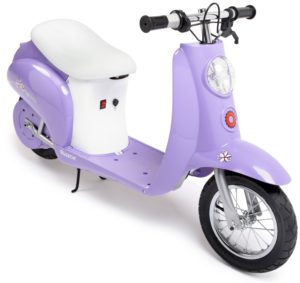 | Razor Pocket Mod Miniature Euro Electric Scooter | Ninety day warranty Weight limit of 170 pounds Available in 7 colors Ten to twelve miles per charge | $$ | 4.5 |
 | YYD ROBO Electric Kick Scooter 350W | 350W Powerful Motor Double Braking System Portable Folding Structure Ultra Long Range Battery | $$ | 4.8 |
 | ReddyRD1 Electric Portable, Foldable Scooter | Weight limit of 880 pounds Sixty miles per charge 65 Mile Long Range Battery Portable Foldable, Off Road | $$$$ | 5.0 |
Razor Pocket Mod Miniature Euro Electric Scooter Review
 The Razor pocket mod miniature Euro electric scooter features a weight limit of 170 pounds and is available in several color options. This vintage-inspired model has the traditional moped look and is ideal for younger children. The scooter weighs in at just under sixty pounds and offers thirty minutes of continuous use before it requires a charge. This model features a 24 volt sealed lead acid battery and a top speed of around fifteen miles per hour. The usage range and top speed can depend on terrain type and the rider’s weight.
YYD ROBO Electric Kick Scooter 350W Review
350W BRUSHLESS MOTOR – Powerful 350W brushless motor propels the electric-powered scooter to reach a top speed of 19mph, having extra torque is what creates enough power to get a vehicle going from, particularly when moving up steep inclines.APP CONTROL TECHNOLOGY – Lock & monitor your electric scooters using our YYD ROBO APP on your mobile device. No matter where you are or what time it is, YYD ROBO app allows you to: check speed and battery life, control the headlight, and lock & unlock your E-Scooter, making it easier than ever to control from anywhere. Safety with YYD SCOOTER – YYD ROBO e scooter features ultra-bright headlights with a range of up to 15 meters to enhance safety. And double braking system features drum braking and eABS regenerative anti-lock braking. BATTERY LIFE – High capacity battery offering a max range of 13miles with a single charge of 5 hours, it is very reliable for various terrains, making the last mile of your commute fast and fun. Traveling range may vary depending on riding conditions, rider’s weight, speed, and/or terrains. QUICK FOLDING DESIGN – Easy folding system for easy portability. YYD ROBO high standard adults scooters can be folded with ease in 3 seconds. Carry it on public transportation, store it in your car and any destination you desire effortlessly.
ReddyRD1 Electric Scooter Review

About The ReddyRD1 Electric Portable, Foldable Scooter
This scooter has a maximum speed of 60 miles per hour. It can handle 45 degrees steep slopes, making it ideal for commuters. The rider can switch between two modes – drive mode and dual-drive mode, depending on their preference or the road conditions they face. This electric scooter usually lasts about 40 to 45 miles when driven in normal driving distance, which is dependent upon several factors including weather, weight/body type of the driver, frequent acceleration & braking, etcetera.
About ScooterMcGoo
Scooter McGoo is an online marketplace for skateboards, longboards, scooters, and Mopeds. We take pride in the personal reviews and tips we share so you can have a better purchasing experience. Scooter McGoo was founded in 2017 and diligently gathers online customer reviews to provide actual customer responses. Check back with us often as we review and share more tips about Scooters, Skateboards, Longboards, and Mopeds. Our website is continually updated with more articles about wheeled products to move you through life. Our target is to have the most effective top-quality website and to educate and entertain our site visitors. If you have any inquiries, you can contact us at any time by utilizing our contact page.